
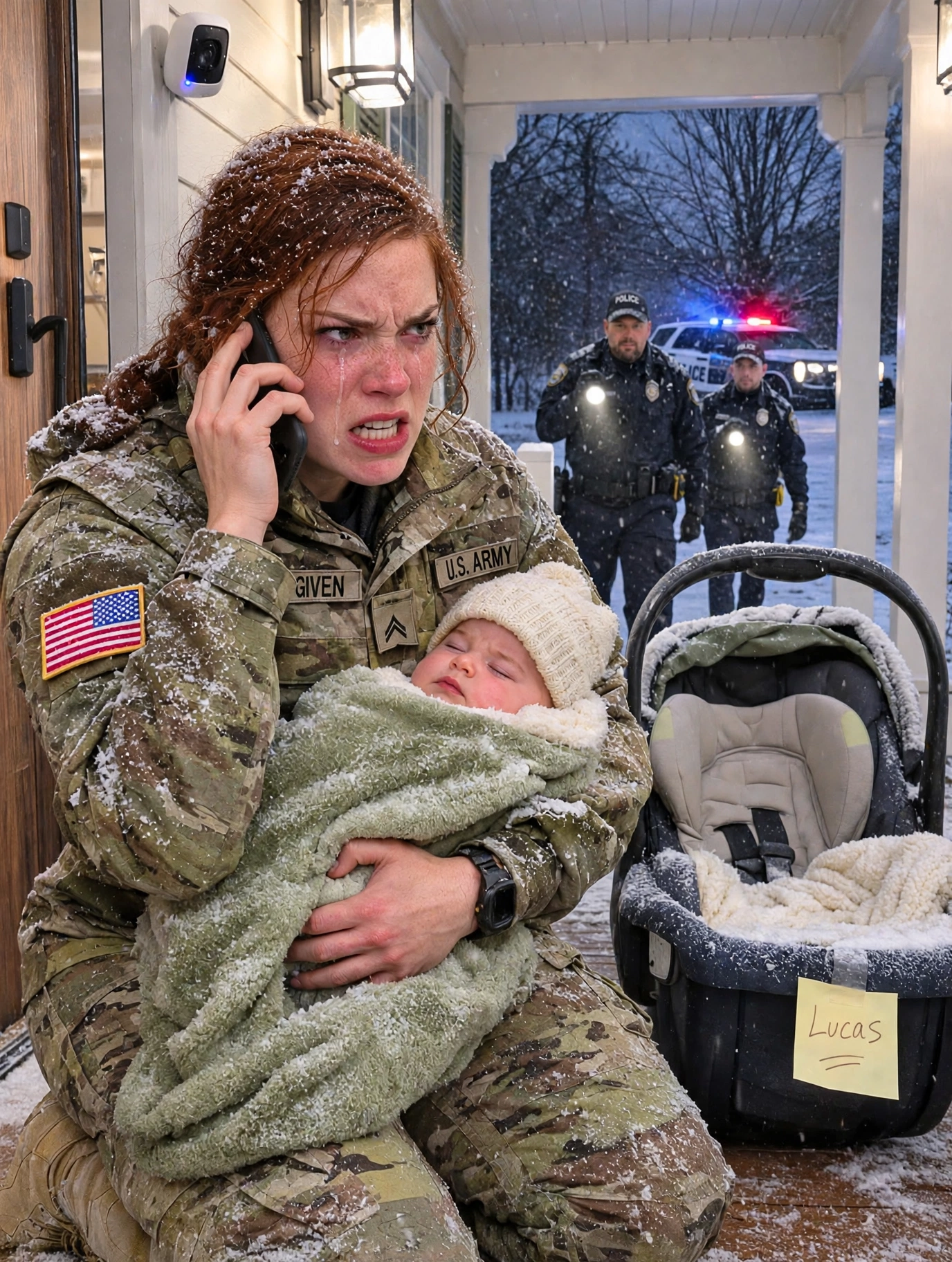
Part 1: The Baby Abandoned on My Frozen Porch
During five years as a sergeant in the Army’s military police, including two tours in the Middle East, I learned how to stay composed in an emergency. Even so, I never imagined that one of the most frightening moments of my life would happen on the front porch of my own home in West Des Moines, Iowa.
It was Saturday, the seventh of February, and my bedside clock showed 5.41 in the morning. My flight to Denver was due to leave at 9.55 that morning, and my childhood friend Carly was expecting me to stand beside her as maid of honour at her wedding.
My olive-green duffel bag and a garment bag holding my plum-coloured bridesmaid dress were already packed beside the front door. I had been hoping for another forty minutes of sleep when the doorbell rang without warning.
Outside, an Arctic weather front had pushed the temperature down to eleven degrees Fahrenheit, with a wind chill of four below zero. I first thought it might be an early delivery, or a neighbour playing a prank, and I considered ignoring it, but something about the moment made me uneasy.
I climbed out of bed, pulled my flannel bathrobe tight around me, and looked out through the front window. The deserted street was covered in drifting snow, and the brick wall around my porch stopped me seeing what was directly outside the entrance.
At 5.49, eight minutes after I had heard the doorbell, I finally unlocked the front door. An icy gust swept inside, and my eyes fell on a familiar grey infant carrier decorated with navy stars, the same one I had bought for my sister at Target.
Inside was my seven-month-old nephew, Luca, covered by a thin fleece blanket that had already begun to gather frost. His cheeks were unusually red, his lips had developed a faint bluish tint, and his weak cries told me at once that something was seriously wrong.
Beside the carrier was a canvas nappy bag, while a bright yellow note had been tucked beneath its protective canopy. I recognised my younger sister Elise’s handwriting immediately.
The note told me, in short, that I was his aunt, that I should sort it out, and that she would be back on Sunday.
My military training took over at once, letting me focus on Luca instead of the anger rising inside me. I carried him into the living room, took off the cold blanket, and held him against my chest to help restore his body warmth.
I spoke softly to him, telling him I had him and his aunt was there.
His tiny hands were freezing, and his trembling body made me realise how dangerous the situation had become. Rather than ringing Elise or asking our mother for an explanation, I called the emergency services immediately.
The dispatcher asked for the address of the emergency. I gave my name, Jamie Given, explained that I was an Army veteran and a claims investigator, and said I had found an abandoned seven-month-old baby showing signs of hypothermia. I asked for paramedics and police officers to be sent straight away.
As the dispatcher confirmed that help was coming, I noticed the blinking blue light on my hallway security system. The high-definition camera above my doorbell had been recording throughout the morning.
The evening before, Elise had demanded that I cancel my flight and babysit Luca for the weekend, claiming she had emergency shifts at work. I had refused outright and suggested that she contact Luca’s father instead.
She had apparently decided that my refusal did not matter, and assumed I would once again give up my plans to fit in with hers. This time, though, she had made a devastating mistake by leaving clear evidence of what she had done directly in front of my security camera.
What I did not yet realise was that the recording would reveal more than a single act of abandonment. It would become the first piece of evidence in a disturbing pattern of deception that my family had spent months helping Elise to hide.
Part 2: The Evidence My Family Wanted Buried
Before I became an automobile damage and fraud investigator in West Des Moines, I had spent years learning to assess dangerous situations without letting my feelings cloud my judgement. My civilian work had reinforced that lesson, teaching me that recorded evidence was often more reliable than people’s explanations.
Paramedics arrived within seven minutes of my emergency call. A medic called Miller examined Luca, confirming that his temperature had fallen to 96.6 degrees Fahrenheit and that he needed further medical assessment.
He told me I had done the right thing by bringing him inside and warming him up, said he was responding well, but added that a paediatrician would need to examine him that day.
Officer Ruben Gaither arrived shortly afterwards and asked whether I could establish exactly when Elise had abandoned Luca. I connected my tablet to the television and opened the security footage.
At 5.40 and 51 seconds in the morning, Elise’s silver Nissan Altima pulled into my driveway. She took Luca’s carrier out of the back seat, placed it on my porch, rang the doorbell, and drove away without waiting for anyone to answer.
The recording went on for eight agonising minutes before it showed me opening the door at 5.49 and two seconds. Gaither took off his glasses, visibly disturbed by what he had just watched.
He said she had not even waited to see whether I was awake.
At his request, I rang Elise at 6.04 in the morning, but the call went straight to voicemail. I sent her a message explaining that Luca had been found outside in dangerously cold weather and that police officers were investigating.
Growing up, I had always been expected to protect my younger sister. After our father left us when I was ten and Elise was five, our mother, Ila, repeatedly insisted that Elise was too sensitive to face the consequences of her mistakes.
I had defended her after a shoplifting incident, paid her outstanding parking fines, and even sent money home during my deployment to Kuwait. Even so, nothing could justify what she had done that morning.
At 6.08, I rang my mother and explained the situation. Instead of expressing concern about Luca’s condition, she immediately began worrying about Elise’s upcoming custody hearing.
She told me not to let the police file a report, because Davin would use it against Elise in April. I told her there was already an officer standing in my kitchen.
She then told me to say it was a misunderstanding between sisters, and that I had been supposed to babysit. I reminded her that I had explicitly refused, because of Carly’s wedding in Denver. Predictably, she demanded that I change my flight and do what she saw as my duty as an aunt.
Officer Gaither interrupted, asking whether Luca’s father was legally recognised. I explained that Davin Mims was an apprentice electrician living in Ankeny.
That was where the account I was given ends, with the police still gathering the facts, Luca in need of medical care, and my family already trying to decide how much of the truth should be told.